 general
 APIs in Logistics: How Digital Integration Transforms Supply Chains
How APIs are enabling seamless communication, fostering innovation, and revolutionizing logistics. A deep dive into digital integration for supply chains.
++
Introduction
In today's hyper-connected world, logistics companies face mounting pressure to deliver faster, cheaper, and more transparently than ever before. The key to meeting these demands lies in the seamless flow of information — a feat made possible by APIs (Application Programming Interfaces). APIs are the unsung heroes powering the modern logistics revolution. They are the invisible engines that connect disparate systems, streamline processes, and unlock new opportunities for growth and efficiency. This comprehensive guide dives deep into how APIs are transforming logistics, offering technical insights, real-world case studies, and practical steps to help you harness their power.

Understanding APIs: The Technical Backbone
At their core, APIs are sets of rules and protocols that allow different software applications to communicate. They define the methods for requesting services, the data formats to use, and the conventions to follow.
Types of APIs in Logistics
1. Restful APIs
Definition: Representational State Transfer (REST) APIs use standard HTTP methods like GET, POST, PUT, and DELETE. Characteristics: - Stateless communication. - Use of JSON or XML for data exchange. Applications in Logistics: - Real-time tracking updates. - Inventory management systems. Example: GET /api/v1/shipments/12345 HTTP/1.1 Host: logisticscompany.com Authorization: Bearer your_api_token This call retrieves the details of shipment 12345.
2. SOAP APIs
Definition: Simple Object Access Protocol (SOAP) APIs use XML-based messaging protocols. Characteristics: - Formal standards and protocols. - Built-in error handling. Applications in Logistics: - Secure transactions. - Legacy system integrations.
3. GraphQL APIs
Definition: A query language for APIs that allows clients to request exactly the data they need. Characteristics: - Efficient data retrieval. - Single endpoint for all queries. Applications in Logistics: - Complex data fetching. - Optimizing mobile app performance.
API Security Measures
Protecting data transmitted via APIs is critical. Key security measures include: - OAuth 2.0: An authorization framework that enables applications to obtain limited access to user accounts on an HTTP service. - API Keys: Unique identifiers used to authenticate requests. - Rate Limiting: Controls the number of API requests a client can make in a given time frame to prevent abuse. - Encryption: Using HTTPS/SSL to secure data in transit.
The Power of APIs in Logistics
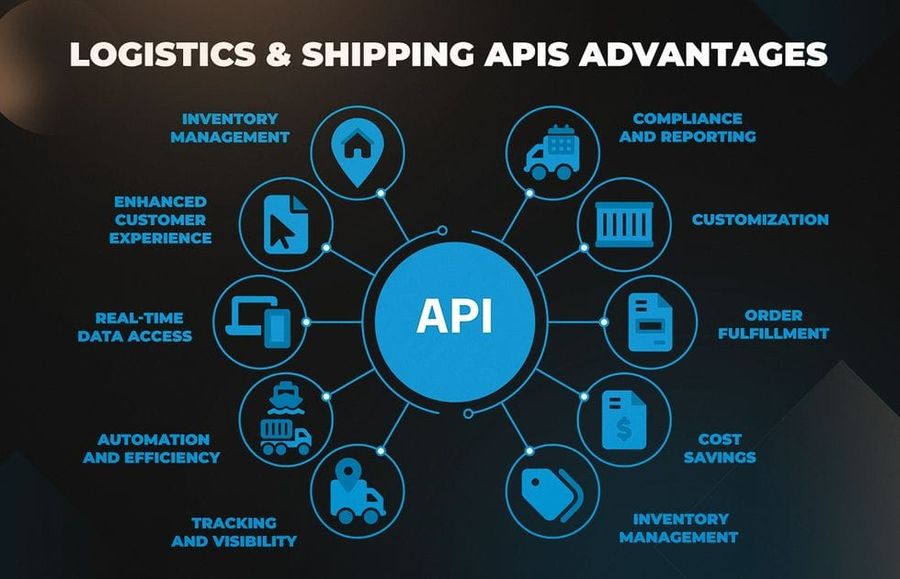
1. Seamless System Integration
The Challenge: Logistics operations often rely on a patchwork of legacy systems that don't communicate effectively. API Solution: - Unified Communication: APIs enable different software systems to exchange data seamlessly. - Real-World Application: Integrating a Warehouse Management System (WMS) with a Transportation Management System (TMS) via APIs ensures inventory levels and shipping statuses are always synchronized. Outcome: - Efficiency Boost: Logistics & trucking companies reported a 25% reduction in processing times after API integration. - Cost Savings: Reduced IT maintenance costs by consolidating systems.
2. Real-Time Data Exchange
The Challenge: Delayed information can lead to missed opportunities and dissatisfied customers. API Solution: - Instant Updates: APIs facilitate real-time data sharing, providing immediate visibility into operations. - Real-World Application: Real-time GPS tracking APIs allow customers to monitor shipments live. Outcome: - Enhanced Decision-Making: Quick response to disruptions saves an average of $50,000 per incident. - Customer Satisfaction: Companies see a 30% increase in customer retention due to improved transparency.
3. Enhancing Customer Experience
The Challenge: Modern customers expect personalized, transparent, and responsive services. API Solution: - Customized Interfaces: APIs enable the creation of tailored customer portals and mobile apps. - Real-World Application: Providing clients with APIs to integrate logistics data into their own systems. Outcome: - Competitive Edge: Businesses offering API-based services gain a significant market advantage. - Revenue Growth: Enhanced customer experiences contribute to a 15% increase in sales.
4. Enabling Innovation and Scalability
The Challenge: Traditional systems can't keep pace with the rapidly evolving logistics landscape. API Solution: - Modular Architecture: APIs support microservices, allowing for scalable and flexible system development. - Real-World Application: Integrating third-party services like AI analytics or blockchain solutions via APIs. Outcome: - Faster Deployment: New features and services can be launched 50% faster. - Future-Proofing: Organizations remain agile and adaptable to technological advancements.
5. Facilitating Collaboration and Partnerships
The Challenge: Siloed data hinders collaboration with partners, suppliers, and customers. API Solution: - Data Sharing Platforms: APIs enable secure and controlled data exchange. - Real-World Application: Sharing inventory levels with suppliers to optimize the supply chain. Outcome: - Stronger Partnerships: Enhanced collaboration leads to joint innovation and shared success. - Supply Chain Optimization: Reduces lead times by 20% and lowers inventory costs.
Case Studies: APIs in Action
Case Study 1: FedEx's API Ecosystem
Overview: FedEx transformed its customer experience and operational efficiency through a robust API strategy. Implementations: - Shipping APIs: Allow customers to create shipments, print labels, and schedule pickups from their own systems. - Tracking APIs: Provide real-time shipment updates. - Rating APIs: Offer instant shipping rate quotes. Challenges Overcome: - Legacy Systems: Modernized outdated infrastructure to support API integration. - Security Concerns: Implemented OAuth 2.0 and API keys to secure data. Results: - Operational Efficiency: Reduced manual processing by 35%. - Customer Empowerment: Over 60% of shipments are now processed via customer-integrated APIs. Client Testimonial: "Integrating FedEx APIs streamlined our shipping process immensely. It reduced errors and improved our delivery times significantly."
Case Study 2: Maersk's Digital Transformation
Overview: Maersk, in partnership with IBM, developed TradeLens — a blockchain-enabled platform powered by APIs. Implementations: - Standardized Data Exchange: APIs facilitate data sharing among over 100 supply chain participants. - Customs Integration: Streamlined compliance processes via API connections with customs authorities. Challenges Overcome: - Data Standardization: Harmonized data formats across diverse stakeholders. - Adoption Hesitancy: Addressed concerns through transparent governance and robust security measures. Results: - Efficiency Gains: Reduced documentation processing times by 40%. - Transparency: Enhanced visibility led to a 20% reduction in transit times. Client Testimonial: "APIs were critical in making TradeLens a reality. They enabled us to connect the fragmented parts of the supply chain securely and efficiently." — Søren Skou, CEO of Maersk.
Expert Roundtable: Voices from the Frontlines
Panelists: - E. Rodriguez, Founder of a logistics company. - M. Lee, Senior API Developer at a supply chain company. - S. Patel, COO of a global freight forwarding company. Question: What future trends do you see shaping API usage in logistics? E. Rodriguez: "APIs will become even more critical as we embrace technologies like AI and machine learning. They will enable the integration of predictive analytics directly into logistics operations." M. Lee: "Security will be a major focus. We'll see advancements in API security protocols, including AI-driven threat detection to safeguard data exchanges." S. Patel: "The rise of 5G and edge computing will revolutionize real-time data processing. APIs will be essential in harnessing these technologies to optimize routing and fleet management on the fly."
Emerging Technologies Shaping API Usage
Edge Computing
Definition: Processing data closer to its source to reduce latency. Impact on APIs: - Enables real-time decision-making in logistics. - APIs facilitate communication between edge devices and central systems.
5G Connectivity
Definition: The fifth generation of mobile networks offering faster speeds and lower latency. Impact on APIs: - Enhances the performance of API calls, supporting real-time data exchange. - Enables more devices to connect simultaneously, expanding IoT applications.
Internet of Things (IoT)
Definition: Network of interconnected devices collecting and exchanging data. Impact on APIs: - APIs are the conduits connecting IoT devices with analytics platforms. - Support automation and predictive maintenance in logistics operations.
Future Trends: The API-First Logistics Era
- API Monetization: APIs will become products themselves, offering new revenue streams. - Hyperautomation: Combining APIs with AI and machine learning to automate complex processes end-to-end. - Blockchain Integration: APIs will enable secure, decentralized data sharing across the supply chain. - Microservices Architecture: Breaking down applications into modular components for greater agility and resilience.
Comparative Analysis: Traditional vs. API-Enabled Logistics
System Integration: - Traditional Logistics: Siloed systems, manual data transfer. - API-Enabled Logistics: Seamless integration, automated workflows. Data Visibility: - Traditional Logistics: Delayed updates, limited transparency. - API-Enabled Logistics: Real-time data exchange, full visibility. Customer Experience: - Traditional Logistics: Generic services, limited personalization. - API-Enabled Logistics: Customized services, proactive communication. Innovation Speed: - Traditional Logistics: Slow, resource-intensive. - API-Enabled Logistics: Rapid, scalable, and flexible. Collaboration: - Traditional Logistics: Challenging, limited data sharing. - API-Enabled Logistics: Enhanced partnerships, shared platforms. Operational Costs: - Traditional Logistics: Higher due to inefficiencies. - API-Enabled Logistics: Reduced through automation and optimization.
Calculating ROI: The Business Case for APIs
Example Calculation: Investment: - API Development and Integration: $200,000. - Training and Change Management: $50,000. - Total Investment: $250,000. Annual Savings: - Reduced Manual Processing Costs: $100,000. - Decreased IT Maintenance: $50,000. - Improved Operational Efficiency: $75,000. - Total Annual Savings: $225,000. ROI: - Payback Period: $250,000 / $225,000 ≈ 1.11 years. - Return on Investment over 3 years: ($225,000 × 3 - $250,000) / $250,000 ≈ 170%. Conclusion: API implementation can yield a significant ROI, with the initial investment recouped in just over a year.
API Integration Checklist and Roadmap
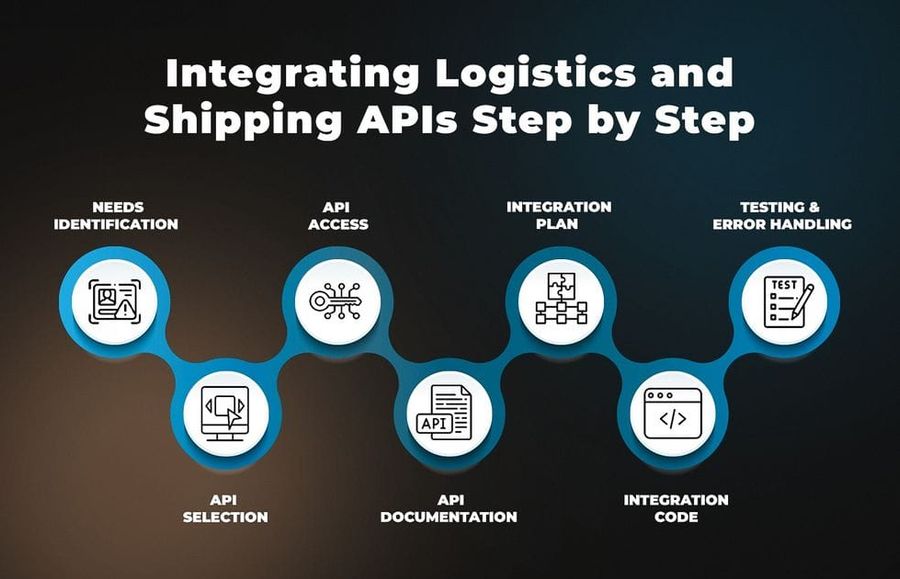
1. Assess Your Needs: - Identify pain points and opportunities for API integration. - Engage stakeholders from IT, operations, and customer service. 2. Define Objectives and KPIs: - Set clear goals (e.g., reduce processing time by 30%). - Establish metrics to measure success. 3. Choose the Right API Strategy: - Decide between developing in-house or partnering with experts. - Select appropriate API types (REST, SOAP, GraphQL). 4. Plan for Security: - Implement OAuth 2.0 or API key authentication. - Establish rate limiting and monitoring. 5. Develop and Test: - Create APIs with scalability in mind. - Conduct rigorous testing to ensure reliability. 6. Train Your Team: - Provide documentation and training materials. - Foster a culture of continuous learning. 7. Launch and Monitor: - Roll out in phases to manage risks. - Monitor performance and adjust as needed.
Mirage Metrics' API Solutions: A Success Story
Company: Transwin. Challenge: - Disparate systems causing inefficiencies. - Lack of real-time data leading to delayed decision-making. - Security concerns with data sharing. Solution Provided by Mirage Metrics: - Custom API Development: Integrated WMS and TMS systems using RESTful APIs. - Real-Time Analytics: Implemented APIs to feed data into a centralized dashboard. - Security Enhancements: Deployed OAuth 2.0 and encrypted data exchanges. Results: - Operational Efficiency: Processing times reduced by 40%. - Cost Savings: Annual savings of $1,500,000 in operational costs. - Improved Security: Zero data breaches reported post-implementation. Client Testimonial: "Mirage Metrics didn't just provide APIs; they delivered a holistic solution that transformed our operations."
Conclusion: Embracing the API Revolution
APIs are not merely technical tools; they are strategic assets that drive efficiency, innovation, and growth in the logistics industry. By embracing APIs, businesses can unlock new opportunities, stay competitive, and meet the ever-evolving demands of the market. Key Takeaways: - APIs enable seamless integration and real-time data exchange. - Security is critical; robust measures must be implemented from day one. - Emerging technologies like edge computing and 5G will amplify the impact of APIs. - The ROI of API implementation is significant and measurable. "The future of logistics is API-driven. Those who adapt will lead; those who don't risk obsolescence."
Glossary of API Terms
- API (Application Programming Interface): A set of protocols for building and interacting with software applications. - RESTful API: An API that uses HTTP requests to GET, PUT, POST, and DELETE data. - SOAP API: A protocol for exchanging structured information using XML messaging. - GraphQL: A query language for APIs that allows clients to request exactly the data they need. - OAuth 2.0: An authorization framework enabling applications to obtain limited access to user accounts. - Rate Limiting: A technique to control the amount of incoming and outgoing traffic to or from a network. - Webhook: An HTTP callback that delivers real-time data to other applications when a specific event occurs. - API Gateway: A server that acts as the single entry point for all API calls, handling routing, authentication, and rate limiting.
MANUFACTURING
READY TO AUTOMATE?
Automate your order intake end-to-end
From email to ERP in seconds — no manual entry, no errors.

++
+

![Fuel Tracking Systems: The Ultimate Guide to Cutting Logistics Costs [2024 Edition]](https://cdn.sanity.io/images/uxovddcv/production/92bad20e3fde090444a81b7b32a07378d3799908-1024x768.jpg?w=600&auto=format&fit=crop)