 orderflow
 Automating Customer Order Entry in SAP in Morocco: Method and Results
How Moroccan industrial companies eliminated manual order re-entry in SAP without an 18-month IT project or expensive consultants.
++
Automating Customer Order Entry in SAP in Morocco: Method and Results
Monday morning, 8:30 AM. An order management assistant opens her inbox. 40 purchase orders received since Friday evening. She prints them. She opens SAP. She starts entering data.
By 11 AM, she has processed 18 orders. Three contain errors she will not catch until the problem surfaces from the field: a reversed product reference, a case quantity entered as units, a delivery address confused between two customer sites. By Wednesday, two deliveries are blocked. The customer calls. The sales rep calls. She re-enters the data.
This scenario is not a management anomaly. It is the operational standard for the majority of Moroccan industrial companies in 2026. It repeats every week, in the order management teams of distribution, food and beverage, construction, and logistics companies. It costs hours, errors, and commercial credibility.
This article explains how Moroccan industrial companies have structurally eliminated this problem. Without replacing SAP. Without an 18-month IT project. Without consultants charging 5,000 euros per day.
Why Manual Re-Entry Costs More Than You Think
The direct cost is visible: time spent on a task with no added value. The real cost is systemic.
An order management operator processes between 25 and 40 orders per day. Manual re-entry of a single order in SAP takes between 8 and 15 minutes depending on the complexity of the source document and the number of line items. Over a standard working day, that represents between 3 and 6 hours of pure labor devoted to transcription. Not to customer relationships. Not to dispute management. Not to delivery optimization. To transcription.
The cost of errors adds to this first layer. In an industrial environment, an order error does not stay contained. It propagates. An incorrect product reference triggers a carrier return. A wrongly entered quantity generates a stock discrepancy that skews the month's forecasts. An incorrect delivery address mobilizes the sales rep, the carrier, and the order team for a correction that takes 2 to 3 hours.
The numbers are straightforward. A 1% error rate on 500 monthly orders means 5 problematic orders per month. Depending on the product value and the nature of the error, the direct cost per incident ranges between 2,000 and 8,000 MAD. This is not a personnel problem. It is an operational design problem.
What Companies That Solved This Problem Actually Did
Companies that eliminated manual re-entry did not rebuild their ERP. They did not launch a digital transformation project. They did one specific thing: they inserted an intelligent layer between the order source and SAP.
This layer reads the incoming document, whether it is a structured PDF, a scan, or a plain-text email. It extracts the necessary fields: product reference, quantity, price, lead time, delivery address. It validates them automatically against the SAP master data. It pushes the order directly into the system. The order management operator re-enters nothing. They supervise exceptions, ambiguous cases, and new formats. Everything else is processed without human intervention.
The operational workflow runs in five steps. The customer sends their order by email, with or without a PDF attachment. The agent reads the document and extracts the structured data needed to create the SAP order. The extracted data is automatically validated against the SAP product catalog, customer master, and commercial conditions. The order is created directly in SAP without human intervention. The order team receives a notification only for cases requiring manual validation: reference exceptions, commercial conditions not yet configured, or unrecognized document formats.
What this workflow eliminates: printing, re-entry, manual verification, and transcription errors. What it preserves: human control over the cases that deserve it.
The Three Order Formats the System Must Handle
For automation to be operationally useful in the Moroccan industrial context, it must cover three distinct document realities.
The structured PDF purchase order. It is sent by major accounts: Marjane, Cosumar, OCP, Maroc Telecom. The format is fixed, repeatable, predictable. Extraction is straightforward and reliability is high. A standard OCR system can handle this case. This is not where the problem lies.
The unstructured PDF purchase order. This is the majority case in Moroccan distribution and industry. Scanned document, variable orientation, format that changes by customer, sometimes partial handwritten annotations in the margins. Classic OCR fails here because it reads pixel coordinates, not intent. An LLM agent understands that "50 crts ref 44B2 Bouskoura" means 50 cartons of reference 4402-B to be delivered to the Bouskoura site, even when no field is explicitly labeled. That is the difference between reading and understanding.
The free-text email order. A buyer writes: "Hi, need 50 cases ref 4402 for next Thursday, delivery to Bouskoura warehouse." No PDF. No form. A conversational message that contains everything needed to create a SAP order. No RPA or OCR system handles this case. An agent processes it in under two seconds.
The ability to cover all three formats simultaneously is the real selection criterion for an order automation system. A system that only handles the first case automates 20% of the problem. The remaining 80% keep going through the order team.
What Changes for the Order Management Team
Results observed at industrial companies that have deployed order entry automation consistently fall within the same range.
Daily re-entry time: from 3 to 5 hours in manual mode, reduced to 15 to 20 minutes of supervision after automation.
Order error rate: from 2 to 4% before, below 0.2% after automation.
Order processing time: from 2 to 4 hours before, real-time processing after.
End-of-month peak load: critical with overtime before, identical to any other day after automation.
Number of order disputes per month: reduced by 80 to 90% after deployment.
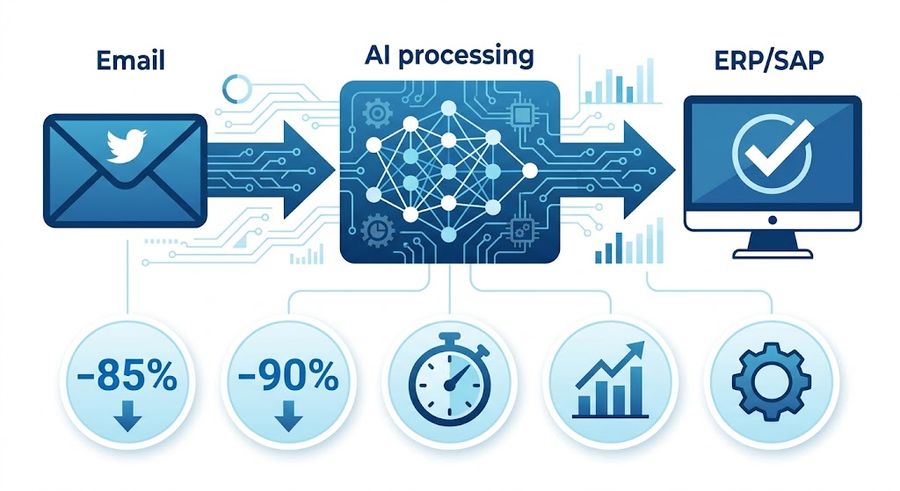
These results apply to a standard order team of 2 to 3 people managing 300 to 600 orders per month. The time recovery is immediate. Errors disappear structurally, not through increased human vigilance, but because manual transcription no longer exists.
What changes in the daily work of the order team: they no longer enter data. They supervise, handle exceptions, and build customer relationships. These are the value-added activities that re-entry had crowded out by consuming all available time.
Why Automation Projects Fail in Morocco
Failures in this area follow three recurring patterns observed in Moroccan field conditions. Identifying them prevents repeating the same mistakes.
First failure: starting with the ERP instead of the document. The classic approach is to try to modify SAP so it accepts orders differently. This is the wrong entry point. SAP is the system of record: you do not touch it, you work upstream of it. The agent processes the document before it enters SAP. The result enters SAP exactly as if an operator had entered it, but without errors and without delay.
Second failure: trying to cover 100% of cases from day one. An automation project that starts by trying to simultaneously handle 15 purchase order formats, 3 ERPs, and 6 languages delivers nothing in 6 months. A pilot on a single customer, a single document format, delivers measurable results in 3 weeks. Coverage expands by iteration from there, based on real results. That is the method that works.
Third failure: choosing a generic tool without a document comprehension layer. UiPath and Power Automate are RPA tools: they copy clicks and reproduce action sequences in an interface. They do not read documents. When a purchase order does not match exactly the format on which the bot was trained, they fail. LLM agents read, understand, and extract regardless of format, because they reason about content, not graphical structure.
Results and Next Step
To automate order entry in SAP in Morocco, the most effective method is to deploy a document processing agent upstream of the ERP workflow, capable of reading all three incoming order formats, validating data against the SAP master data, and creating orders without human intervention on standard cases.
Moroccan industrial companies that have eliminated re-entry typically use a two-phase deployment: a 3 to 4 week pilot on a representative order segment, followed by full deployment across the entire incoming flow. Return on investment is visible from the first month of operation.
A Moroccan industrial company processing 300 orders per month recovers between 60 and 90 hours of order team labor per month. This is not a digital transformation project. It is an operational decision.
MANUFACTURING
READY TO AUTOMATE?
Automate your order intake end-to-end
From email to ERP in seconds — no manual entry, no errors.

++
+

