 orderflow
 How Distributors Scale to 3x Order Volume Without Adding Headcount
Hiring more CSRs to handle order growth is a trap. Here is how distributors are scaling to 3x order volume with the same team size using automation.
++
How Distributors Scale to 3x Order Volume Without Adding Headcount
The standard response to growing order volume is hiring. Another CSR, then another, then a supervisor to manage the growing team. Each hire adds capacity, but also adds cost, training time, and organizational complexity. At some point, the margin per order starts shrinking even as revenue grows.
There is an alternative. A growing number of mid-size distributors are handling two, three, and in some cases five times their previous order volume with the same customer service headcount. The mechanism is not working the existing team harder. It is changing what they spend their time on.
This article covers the mechanics of how that works, where the real capacity bottleneck sits in most distribution operations, and what the transition looks like in practice.
Why Hiring More CSRs Does Not Scale
Hiring feels like the natural solution to an order volume problem because it directly addresses the constraint: more orders need more people to process them. But the economics of CSR hiring in distribution are worse than they appear.
First, there is the ramp time. A new CSR needs four to six weeks before they are processing orders at full speed. During peak growth periods, that ramp time means new hires are not useful when you need them most.
Second, there is turnover. Annual CSR turnover in distribution runs at 20 to 25 percent. Continuous hiring means continuous training, and continuous training means senior reps spending time on knowledge transfer instead of handling the accounts that need experienced attention.
Third, the per-order cost does not decrease with headcount. The tenth CSR costs approximately the same as the second. Unlike almost every other investment in distribution operations, adding people to the order entry function provides no economies of scale.
Fourth, and most importantly, hiring addresses the symptom rather than the cause. The constraint is not a shortage of people willing to type orders into an ERP. The constraint is that manual data entry is inherently low-throughput work that requires a full human to execute a task that could be largely automated.
Where the Time Actually Goes
Before changing anything, it helps to understand how CSR time is actually allocated in a typical distribution operation.
A time study across mid-size distributors consistently produces approximately the following breakdown:
Data entry: 38 to 45 percent of working time. Opening orders, reading them, looking up SKUs, checking inventory, applying pricing, posting to ERP, sending confirmations. This is the core manual entry process.
Lookup and research: 20 to 28 percent. Searching for part numbers, cross-referencing customer catalogs, checking availability across locations, researching backorder status. Much of this is triggered by the gaps and ambiguities in incoming orders.
Status and follow-up calls: 15 to 20 percent. Customers calling to check order status, reps calling to confirm details, internal calls to warehouse or purchasing about specific orders. Most of this call volume is a direct consequence of slow order confirmation times.
Exception handling and problem resolution: 10 to 15 percent. Resolving errors, processing credits, managing returns, handling escalations. This is the highest-value work a CSR does, requiring genuine judgment and customer relationship skills.
Administrative and other: 5 to 10 percent. Meetings, training, system maintenance.
The first three categories, which account for 73 to 93 percent of CSR time, are either automatable or substantially reducible through automation. The fourth category, exception handling and problem resolution, is the one that genuinely requires human expertise.
The Capacity Equation
When an automated system handles data entry and lookup, the capacity math changes entirely.
A CSR who was processing 45 orders per day through manual entry now reviews 15 to 20 exception cases per day. The remaining 25 to 30 orders that previously required their time process automatically. That same CSR now has four to five hours of their day freed for other activities.
In a team of four CSRs, that represents 16 to 20 hours of daily capacity that was previously consumed by data entry and is now available for higher-value work. The team can handle three to four times the previous order volume because the marginal cost of each additional automatically processed order approaches zero.
This is not a theoretical projection. It is the consistent reported outcome from distributors who have implemented order automation. The limiting factor in a well-implemented automated operation is not processing capacity but exception handling capacity, and exception handling scales much more efficiently with human effort than raw data entry does.
What Happens to the Team
The honest conversation about order automation always includes the question of what it means for the people doing manual entry today. The answer matters both for practical reasons and because how you handle the transition determines whether the team supports or resists the change.
The experience of distributors who have made this transition is consistent: the CSR role improves. The work that automation handles, looking up SKUs, typing data into the ERP, confirming orders, is the least engaging and least valued part of the job. It is also the most error-prone and the most mentally fatiguing when done at volume for hours at a time.
The work that remains after automation, exception handling, account management, problem resolution, proactive customer contact, is the work that experienced CSRs describe as the reason they like the job. It requires judgment, product knowledge, and relationship skills. It is also better compensated over time because it is genuinely harder to replace.
Distributors who have implemented automation consistently report that CSR retention improves after the transition. The correlation is not surprising. People stay in jobs where they are doing meaningful work. People leave jobs where they spend most of their day on repetitive data entry.
The Scaling Ladder: Where Each Threshold Sits
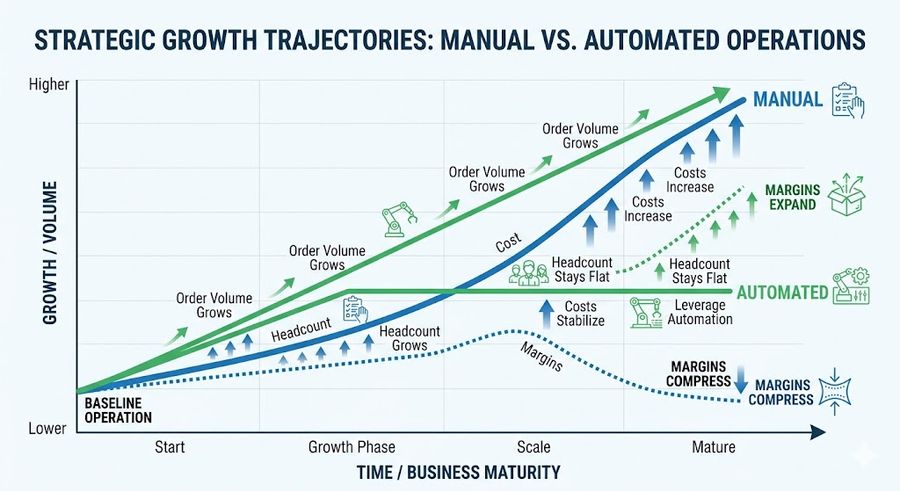
For planning purposes, it helps to understand how order volume relates to team capacity at different stages of manual versus automated operations.
Under 100 orders per day: Manual processing is manageable with one to two CSRs. Errors are correctable. Automation provides improvement but the urgency is lower.
100 to 250 orders per day: The manual process starts showing strain. Confirmation times lengthen during peak periods. One CSR absence creates a backlog. This is the range where automation provides the clearest operational benefit relative to implementation cost.
250 to 500 orders per day: Manual processing at this volume requires three to five CSRs and creates consistent pressure during busy periods. Error rates increase because speed becomes more important than accuracy. Teams in this range who implement automation typically see the most dramatic capacity improvement.
Over 500 orders per day: Manual processing at this scale is a significant organizational challenge. Multiple CSRs, quality control processes, supervisory overhead. Automation is nearly always cost-justified within weeks of go-live at this volume.
The Non-Obvious Benefit: Consistent Quality at Scale
There is a benefit to automated order processing that rarely appears in ROI calculations but is significant in practice: the quality of processing does not degrade as volume increases.
A CSR processing 40 orders on a Tuesday morning produces different quality than the same CSR processing 80 orders on a Thursday afternoon in peak season. Fatigue, time pressure, and the sheer cognitive load of a high-volume period all increase error rates and reduce the thoroughness of each individual order review.
An automated system processes the 80th order with exactly the same validation logic as the first. The exception rate stays constant regardless of volume. Confirmation times do not lengthen during peak periods. The customer experience is consistent whether they are ordering in January or during the spring surge.
This consistency has direct customer retention value. Customers who experience reliable, fast order confirmation in normal periods and the same reliable, fast confirmation during your busiest weeks develop a different level of trust in your operation than customers who experience fast confirmation in normal periods and slow, error-prone processing when you are at peak capacity.
Case Study: Plumbing Distributor Scales from 180 to 520 Orders Per Day
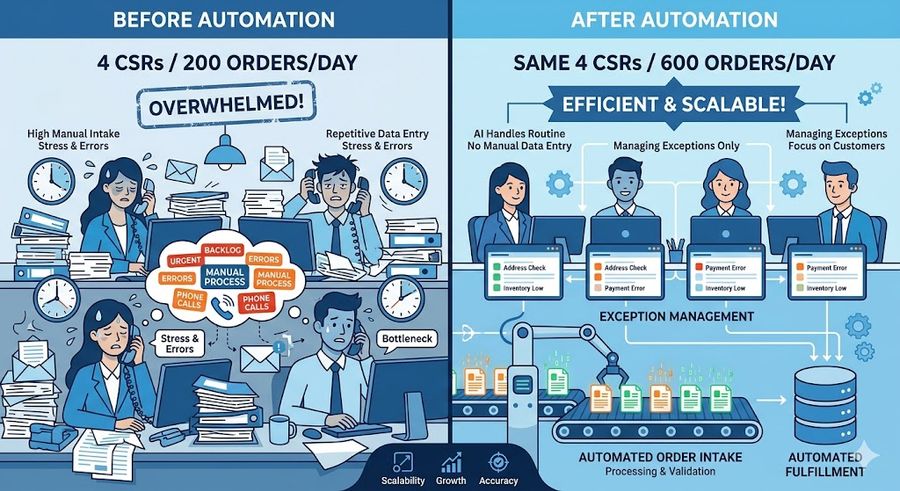
A plumbing supply distributor had a customer service team of four reps processing approximately 180 orders per day. Order volume had grown 40 percent over the previous two years, and the team was showing the strain. Overtime had become routine during the busiest periods, and the error rate on orders entered during high-volume mornings was measurably higher than during slower periods.
The operations manager mapped the team's time allocation and found that 42 percent of working hours were going to order data entry, 24 percent to lookup and research, and 16 percent to status and follow-up calls. Exception handling and meaningful customer interaction accounted for less than 18 percent of the team's time.
After implementing automated order intake:
Order processing capacity reached 520 orders per day within three months, with the same four-person team
Overtime was eliminated entirely outside of one peak week per quarter
CSR time on data entry fell to less than five percent of working hours (exception review only)
The team was redirected toward proactive account management, resulting in a 12 percent increase in average order value from existing accounts over the following six months
CSR turnover, which had been running at 25 percent annually, dropped to zero in the 18 months following implementation
The capacity improvement alone justified the platform cost within the first 60 days.
Getting Started
The first step is the time allocation audit: how does your CSR team actually spend their working hours, broken down by task category? For most operations, this is the first time anyone has measured it, and the results consistently show that 70 to 80 percent of CSR time is spent on work that automation can handle.
From that baseline, the capacity projection is straightforward: if automation handles 80 percent of the current task load, what does the team do with the freed capacity, and how much order volume can they support at the new task mix?
The answer is almost always significantly more than the current volume, often two to three times more. The question is how quickly you want to capture that capacity.
Want to map the capacity opportunity for your specific team? Book a 30-minute session with the OrderFlow team.
MANUFACTURING
READY TO AUTOMATE?
Automate your order intake end-to-end
From email to ERP in seconds — no manual entry, no errors.

++
+

