 orderflow
 MRO Distributor Order Automation: Handle Complex SKU Catalogs at Scale SLUG
MRO distributors managing 50,000+ SKUs can't afford manual order entry. Here's how automation handles catalog complexity without breaking down.
++
Most distributors talk about order volume as the core challenge. For MRO distributors, volume is only half the problem. The other half is complexity.
A typical MRO catalog runs between 50,000 and 500,000 active SKUs. Customers order bearings, seals, cutting tools, filters, and fasteners, often without knowing the exact part number. They describe what they need, expect you to find it, and need it fast because a production line is down.
Manual order entry in that environment is not slow. It is structurally broken.
What Makes MRO Order Processing Different
A building materials order is complex. An electrical distributor order is complex. MRO order processing is in a different category entirely.
Here is what a CSR deals with on a typical MRO order:
The customer submits a purchase order with a mix of their own internal part numbers, manufacturer part numbers, and plain language descriptions. Some of those parts are current. Some have been superseded by newer versions. One or two may be discontinued with no direct replacement.
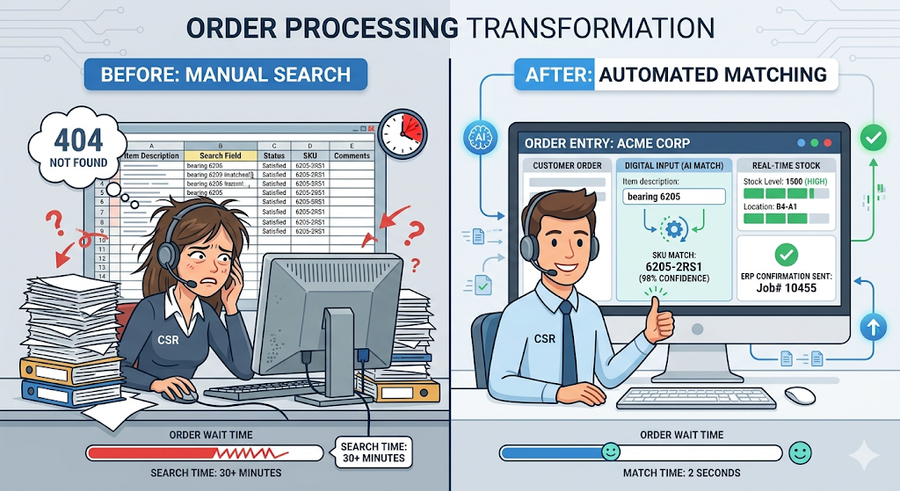
The CSR needs to look up each line item, cross-reference the customer's part number against the catalog, check for superseded versions, verify stock across locations, apply customer-specific pricing, check minimum order quantities, and flag anything that needs to go on backorder.
For a ten-line order, that process takes six to ten minutes. For a thirty-line order, it can take the better part of an hour.
And MRO customers typically do not send one order a day.
The SKU Matching Problem at Scale
The core challenge in MRO order processing is that there is no standard language for parts. A 6205 bearing might come in on an order as:
"6205-2RS"
"SKF 6205"
"bearing 6205 double seal"
the customer's internal code "BRG-447"
a competitor's part number from a previous supplier
All of these describe the same part. A CSR who knows the catalog can usually work it out. An inexperienced CSR, or one who is processing forty orders before noon, will make mistakes.
A trained order automation system handles this through a layered matching process. First, it checks for an exact SKU match. If none is found, it searches the manufacturer cross-reference database. If that returns multiple results, it uses the customer's order history to determine which version they typically purchase. If the match is still ambiguous, it flags the line for human review rather than guessing.
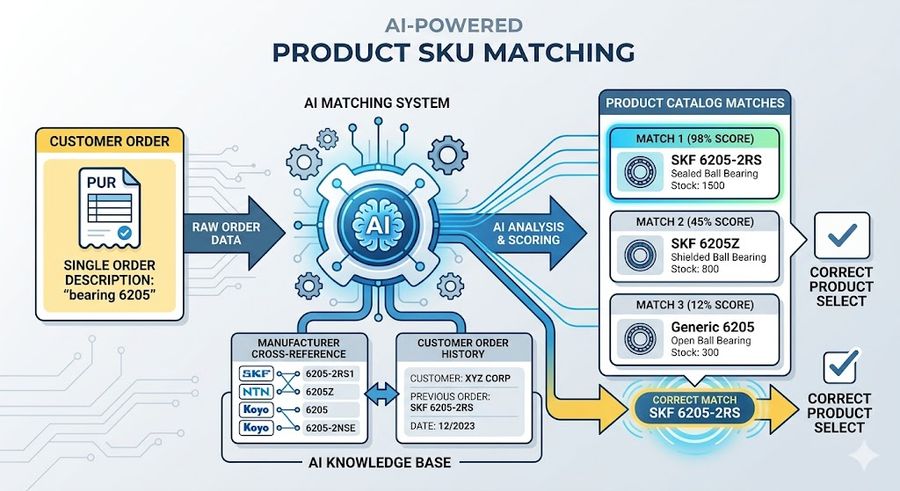
Over time, as the system processes more orders for each customer, the exception rate on SKU matching drops significantly. Most MRO distributors running automated order intake see ambiguous match rates fall below three percent within the first ninety days.
Superseded and Discontinued Parts
Superseded part handling is where manual processes fail most visibly.
A customer orders a part number that was valid eighteen months ago. The manufacturer has since released an updated version with a new number. The old number is still in the catalog as a cross-reference, but the CSR does not catch it, ships the old version if it is in stock, or creates a backorder for a part that will never be replenished.
An automated system flags superseded parts at the point of order entry and presents the replacement SKU for confirmation. The customer gets an accurate order acknowledgment before anything ships, and the distributor avoids the downstream cost of a return or a backorder that cannot be filled.
Discontinued parts are handled the same way. When a customer orders something that is end-of-life with no direct replacement, the system flags it immediately and routes it to a rep who can have a real conversation about alternatives, rather than letting the order sit until someone notices.
Minimum Order Quantities and Customer-Specific Pricing
MRO pricing is rarely straightforward. National accounts have negotiated rates. Maintenance contracts include special pricing tiers. Some customers have blanket purchase orders with pre-approved pricing that cannot be overridden.
Manual application of customer-specific pricing is a consistent source of margin leakage. A CSR processes an order under time pressure, applies the standard rate, and does not notice the customer has a contract price that is twelve percent lower. The customer notices on the invoice, calls back, and the correction costs time and goodwill on both sides.
Automated order processing pulls customer-specific pricing from the ERP at the point of order creation. There is no lookup step, no manual application, and no override opportunity. The price on the order acknowledgment is the price in the contract, every time.
Minimum order quantities work the same way. When a customer orders below the MOQ for a line item, the system flags it before the order is posted, not after it reaches the warehouse.
Backorder Workflow Automation
Backorders in MRO distribution are common and operationally expensive. A part is out of stock, the customer needs it, and someone has to manage the communication, the alternative sourcing, and the eventual fulfillment.
Without automation, backorder management is a spreadsheet and a lot of manual follow-up. CSRs check on open backorders, call suppliers, and update customers on expected ship dates, all manually, all in parallel with processing new incoming orders.
An automated backorder workflow handles the communication layer automatically. When a line item goes on backorder, the customer receives an acknowledgment with the expected date. When that date changes, they receive an update. When stock arrives and the backorder ships, they receive a confirmation.
CSRs are notified only when a backorder requires a decision: supplier substitution, expedite request, or customer escalation. Everything else runs without manual intervention.
ERP Integration: Infor, Epicor, and Beyond
The value of order automation is only realized when the output connects cleanly to your ERP. An automated intake process that requires manual re-entry at the posting step has not solved the problem.
OrderFlow integrates natively with Infor CloudSuite Distribution, Epicor Prophet 21, Epicor Eclipse, and several other ERP platforms commonly used in MRO distribution. When an order passes validation, it posts directly to the ERP as a confirmed sales order. The customer receives an acknowledgment, inventory is reserved, and the warehouse team sees the pick list without anyone touching the transaction.
Custom ERP configurations, customer-specific pricing tables, and branch-level inventory logic are all handled within the integration layer, not worked around.
Case Study: Industrial MRO Distributor Handles 3x Order Volume Without Adding Staff
A regional MRO distributor serving manufacturing plants in the Midwest was processing approximately 280 orders per day with a customer service team of six. Their catalog ran to just over 90,000 active SKUs, and a significant portion of incoming orders used customer-internal part numbers that required manual lookup.
At peak periods, order confirmation times stretched to four hours. Customers called to check status. Backorder communication was inconsistent. The team was stretched thin enough that training new hires was treated as a liability rather than an opportunity.
After deploying automated order intake with SKU matching and ERP integration:
Order processing capacity reached 850 orders per day with the same team
Average order confirmation time dropped to under 45 seconds for clean orders
SKU match exceptions (orders requiring human review) settled at 2.8 percent of line items after 60 days
Backorder communication became fully automated, eliminating approximately 90 inbound status calls per week
The team redirected time to proactive account management, contributing to a measurable increase in repeat order frequency
The Case for Starting with Automation Before the Next Catalog Expansion
Most MRO distributors plan to grow their catalog. More SKUs means more customer coverage and more revenue opportunity. It also means more complexity in every order that comes through the door.
Manual order processing does not get more efficient as the catalog grows. It gets slower, more error-prone, and more expensive per order. The right time to implement automated intake is before the next major catalog expansion, not after.
A system that handles 90,000 SKUs correctly handles 150,000 SKUs with the same logic. The matching rules, cross-references, and pricing tables update in the background. The CSR team does not feel the difference.
Getting Started
The first step is usually an audit of your current order exception rate: what percentage of incoming orders require manual intervention before they can be posted to the ERP, and why. For most MRO distributors, that number is higher than expected.
From there, implementation follows a structured onboarding: catalog ingestion, cross-reference mapping, customer account linking, and ERP connection. Most distributors are processing live orders through the automated system within 30 days.
If your team is spending meaningful time on SKU lookups, part cross-referencing, or backorder communication, that time is recoverable. The question is how much of it you want to recover before the next busy cycle.
Want to see how OrderFlow handles your specific catalog complexity? Book a 30-minute demo with the team.
MANUFACTURING
READY TO AUTOMATE?
Automate your order intake end-to-end
From email to ERP in seconds — no manual entry, no errors.

++
+

