 orderflow
 Phone Order Automation: Process 300 Calls Daily Without a Call Center
Most distributors cap out at 40 phone orders a day per rep. Here is how voice-to-order automation handles 300 calls daily without a call center.
++
The phone is the oldest order channel in distribution. It is also the most expensive.
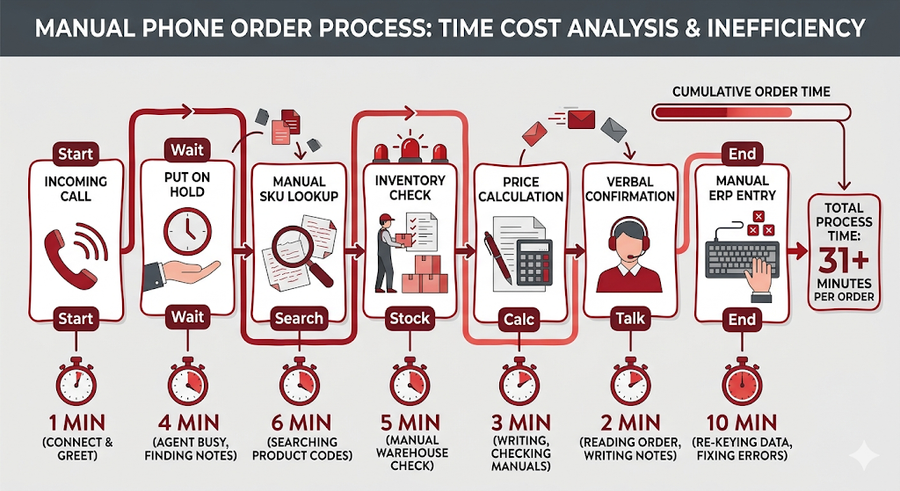
Every phone order requires a rep to stop what they are doing, pick up, identify the customer, look up products, check inventory, calculate pricing, read back a confirmation, and then manually enter the whole thing into the ERP. On a good day, that takes four to six minutes per call. On a busy day, with customers on hold and the inbox filling up at the same time, it takes longer.
Most distributors cap out at 35 to 45 phone orders per rep per day. That ceiling does not move unless you hire more people or change the process.
This article covers how voice-to-order automation removes that ceiling without building a call center.
Why Phone Orders Break Distributor Operations
Phone orders create a specific kind of operational pressure that other channels do not. When an email order comes in, it waits. When a fax arrives, it waits. When a customer calls, they do not wait. They are on the line, expecting a response in real time.
That real-time pressure forces reps into a mode where speed matters more than accuracy. Lookups get rushed. Pricing gets estimated. Order details get summarized instead of confirmed. The rep says "I'll call you back if there's a problem" and hangs up hoping nothing was missed.
The error rate on phone orders is consistently higher than on any other channel. The downstream costs are also higher: corrections require another call, returns require coordination, and incorrect shipments are expensive in both time and relationship.
Beyond errors, the capacity problem compounds over time. As order volume grows, more reps are needed to cover the phones. But phone reps are also the same people handling emails, managing backorders, and dealing with customer escalations. The phone becomes a constant interruption that prevents every other task from getting done properly.
How Voice-to-Order Automation Works
A voice-to-order system handles inbound calls without requiring a human to manage each transaction. Here is what happens on a typical call:
The customer calls your order line. The system identifies them by phone number, pulling up their account, order history, and pricing tier before they finish saying hello. If the number is unrecognized, the customer is asked for their account number or company name, which is matched against the database in real time.
The customer places their order verbally. The system transcribes and parses the request, mapping product descriptions to SKUs using the same catalog matching logic used for email orders. It handles natural language: "six of the half-inch ball valves we got last month" resolves to the correct SKU based on order history, even without a part number.
As each line item is processed, the system checks real-time inventory availability and applies customer-specific pricing. If an item is out of stock, the customer is informed immediately and offered alternatives or a backorder.
At the end of the call, the system reads back a complete order summary for confirmation. The customer approves, the order posts directly to the ERP, and a confirmation is sent to their email. The entire call takes two to three minutes for a typical order.
Handling Complex Orders
The concern that comes up most often is whether automated voice processing can handle the kind of complex, multi-line orders that experienced reps navigate intuitively. The answer depends on how the system is trained, but well-implemented voice-to-order automation handles most of what comes through on a typical day without issue.
Multi-line orders are handled sequentially. The system processes each item as the customer speaks it and confirms each line before moving to the next. Customers who jump between topics or revise quantities mid-order are handled through natural conversation flow rather than rigid scripting.
Where the system reaches its limits, it transfers to a human rep with a full transcript of the call so far. The rep picks up with context rather than starting from scratch. This means that automation handles the volume and humans handle the exceptions, rather than humans handling everything.
Customer Identification and Account Management
One of the practical advantages of phone automation over manual handling is that customer identification happens before the conversation begins. The system knows who is calling, what they typically order, and what pricing applies.
For regular customers, this means the call feels faster and more responsive than a manual interaction. The system can prompt: "Based on your last order, would you like to reorder the same items?" Repeat orders take under sixty seconds.
For new customers or unrecognized numbers, the onboarding flow collects account information and creates a record that enriches future calls. Over time, the system builds a behavioral model for each customer that makes every subsequent interaction faster.
Real-Time Inventory and Pricing During the Call
One of the failure modes in manual phone order processing is that reps often do not have inventory visibility while on the call. They quote availability based on memory or general knowledge, then discover a stock problem when they go to enter the order after hanging up. That requires a callback, which is time-consuming and damages customer confidence.
A voice-to-order system checks inventory in real time during the call. When a customer asks for a quantity that exceeds current stock, the system knows immediately and presents the options: partial shipment, backorder, or alternative product. The customer makes a decision on the spot, and the order reflects it accurately.
Pricing is handled the same way. The system applies the customer's contracted rates, volume breaks, and any active promotions without the rep needing to look anything up or make a calculation.
Integration with Your Phone System
Voice-to-order automation integrates with standard business phone systems and VoIP platforms. Calls route to the automated system during business hours or always-on, depending on configuration. After-hours calls can be handled with a self-service flow that accepts orders and confirms them for next-day processing, eliminating the gap between when customers want to place orders and when your team is available to take them.
For distributors with multiple branches, calls can be routed based on account assignment or geography, with each branch maintaining its own inventory context.
Case Study: Manufacturing Distributor Goes from 40 to 300 Daily Calls
A manufacturing distributor in the Midwest was handling approximately 40 inbound phone orders per day per rep, with a team of three. At peak periods, calls were going to voicemail. Customers left messages, reps called back when they could, and orders were placed hours after the initial contact.
The distributor's customers were predominantly small and mid-size manufacturers who preferred phone orders out of habit. Asking them to shift to email or a portal was not a realistic option in the short term.
After deploying voice-to-order automation:
Daily phone order capacity reached 300 calls without adding any staff
After-hours order capture began for the first time, accounting for roughly 18 percent of total phone order volume within the first month
Order error rate on phone orders dropped by 71 percent, measured by corrections and returns
Rep time previously spent on inbound calls was redirected to outbound account management, contributing to a measurable increase in average order value
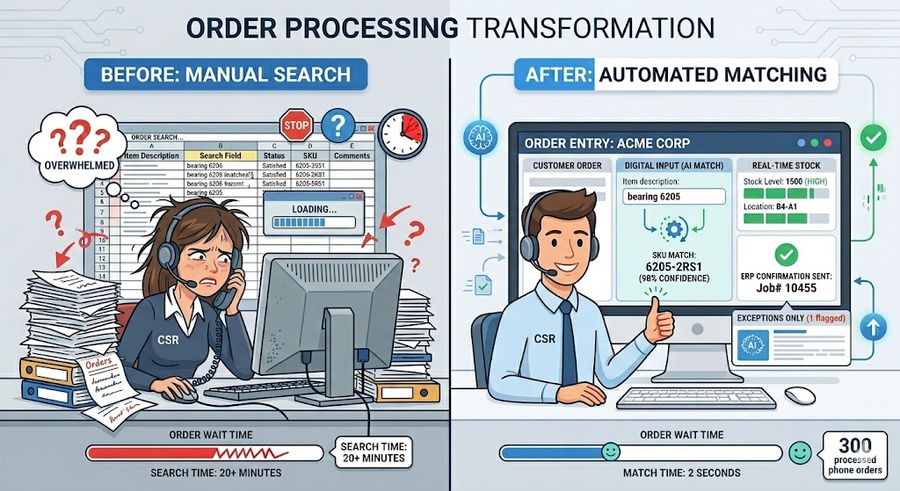
The customer base did not need to change their behavior. The distributor changed its infrastructure instead.
The After-Hours Opportunity
Most distributors treat their order window as their business hours. Customers who call at 6 AM or 7 PM leave messages that get processed the next morning, at best.
For many manufacturing and industrial customers, orders need to be placed when the decision is made, not when the office opens. A production planner reviewing inventory at 9 PM and identifying a shortage does not want to wait until morning. They want to place the order and know it is in the queue.
Voice-to-order automation makes 24-hour order intake possible without staffing. After-hours calls are handled by the same system, with orders queued for next-day fulfillment and confirmations sent immediately. Customers know their order is in. Nothing gets lost overnight.
Getting Started
Most voice-to-order deployments start with a pilot on a subset of incoming calls, typically the highest-volume product categories where SKU matching is most predictable. Once accuracy and call flow are validated, the system is expanded to full order intake.
The learning curve for customers is minimal. The system is designed to work with how people actually speak on the phone, not how software wants them to input data. Most callers do not realize they are interacting with an automated system until they think to ask.
If your reps are spending a significant portion of their day on inbound phone orders, or if you are losing after-hours business to voicemail, the capacity math on voice-to-order automation is usually straightforward.
Curious what voice-to-order would look like for your call volume? Book a 30-minute demo with the OrderFlow team.
MANUFACTURING
READY TO AUTOMATE?
Automate your order intake end-to-end
From email to ERP in seconds — no manual entry, no errors.

++
+

