 orderflow
 Reducing Order Entry Errors in Your ERP: Real Causes and Operational Fixes
ERP order entry errors are not a people problem. They are a design problem. Here are the 5 real causes and the only structural fix.
++
Reducing Order Entry Errors in Your ERP: Real Causes and Operational Fixes
Order entry errors are not a people problem. They are an operational design problem.
A competent, trained, motivated order management operator re-entering 40 orders per day under normal conditions will generate between 1 and 3 errors. Not because they lack diligence. Because the human brain is not built for repetitive transcription of alphanumeric data for 4 consecutive hours without a degradation in accuracy. This is not a judgment on the quality of the team. It is physiology.
This reality is the source of 80% of the ERP errors observed in Moroccan industrial companies. The remainder comes from poorly designed processes that amplify the natural failure modes of manual entry rather than absorbing them.
This article lays out the complete diagnosis. It identifies the five most common error sources, their real cost on operational profitability, and why standard solutions fix nothing durably. The only structural correction is presented for what it is: an architectural decision, not an additional management effort.
The Five Most Common Error Sources
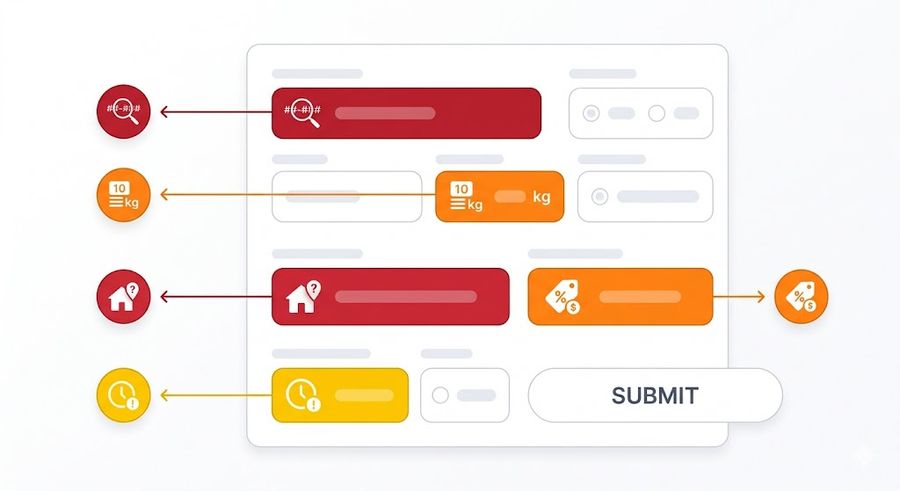
ERP order entry errors are not random. They concentrate on five identifiable and measurable friction points.
The product reference is the most frequent and least visible error source. The customer orders reference "4402-B". The operator enters "4402B" or "4042-B". SAP sometimes accepts both variants, the order goes through, and the inventory tracking records a movement against the wrong reference. The error is only caught at inventory count, weeks later, when the discrepancy has become inexplicable.
Quantities and units generate the most costly errors in absolute value. Confusion between cases and units, between pallets and packages, is particularly common in Moroccan food industry and distribution where the same products circulate in packaging formats that vary by customer. A unit discrepancy on an order of 200 references creates a stock variance that skews procurement forecasts for the entire month.
Delivery addresses create immediate and visible operational incidents. A major Moroccan industrial account often has 3 to 8 different delivery sites in the SAP master data. The operator selects the wrong one from the dropdown. The carrier heads to Kenitra. The order was for Berrechid. The correction cost combines the carrier return, the rescheduled delivery, and commercial time to manage the customer.
Prices and commercial conditions produce errors that do not appear in operations but in billing. The customer has a negotiated discount outside the standard SAP update cycle. The operator applies it manually if they remember, or does not apply it. The invoice is wrong either way: either the customer is overcharged and disputes it, or the company undercharges and loses margin without realizing it immediately.
Lead times and priorities are the most silent error source. The order is urgent according to the customer, standard according to the ERP. The information was not captured at entry time because it was in the body of the email and not in the attached purchase order. The order is processed in normal sequence. The customer expected express delivery. The commercial incident that follows appears in no data quality metric, but it measurably damages the customer relationship.
What These Errors Really Cost
The cost of ERP errors is systematically underestimated because it is spread across multiple departments and appears in no consolidated report.
A Moroccan industrial company processing 400 orders per month, with an average order value of 15,000 MAD and a 3% error rate, generates 12 incorrect orders per month.
Five of them trigger a carrier return. The direct cost per return ranges between 400 and 800 MAD depending on distance and carrier. That is between 2,000 and 4,000 MAD in pure logistics cost.
Four generate a customer credit note. The administrative cost of processing a credit note regularly exceeds 1,500 MAD per case. That is an additional 6,000 MAD.
Three generate a localized stockout or overstock on a reference, with a knock-on impact on procurement forecasts that is difficult to isolate but real.
The direct monthly cost of these 12 incorrect orders runs between 15,000 and 40,000 MAD depending on the sector and product values. Over 12 months, a mid-size company with this order profile carries between 180,000 and 480,000 MAD in annual cost directly attributable to ERP entry errors.
Why Standard Solutions Do Not Work
The standard responses to ERP order entry errors are behavioral. They fail because the problem is architectural.
Repeat training does not change the structural error rate. It may reduce it temporarily after an intensive session. It returns to its prior level within 6 to 8 weeks. The human brain under repetitive cognitive load degrades its accuracy regardless of training level.
Double-checking doubles processing time without eliminating errors. It reduces them, at best, by 40 to 60%. The residual rate stays above 1%. And the company now has two operators on a task that previously required one.
Manual control checklists are applied rigorously the first two weeks after introduction. They are partially ignored within a month. They are systematically bypassed during order volume peaks, precisely when their usefulness would be greatest.
Strengthened management supervision creates pressure without correcting the error generation mechanism. It shifts the problem to the human dimension without solving it at the operational level.
All of these solutions share one characteristic: they treat the symptom. None of them changes the cause: the fact that a human being is manually transcribing data from a document into an ERP field, 400 times per month.
The Structural Fix: Eliminate Entry, Not Supervise It
The only way to eliminate entry errors is to eliminate entry. Not reduce it. Eliminate it.
An agent that reads a PDF purchase order and pushes the structured data into SAP does not make transcription errors. It can make extraction errors, which are of an entirely different nature: a misinterpreted field is automatically detected before it enters the ERP because it does not match any known reference in the catalog, or because the extracted quantity is outside the normal ranges for that customer. These extraction errors are filtered upstream. They never enter SAP without triggering an alert.
The exception-handling workflow operates as follows. The agent processes 93 to 97% of orders automatically depending on the variety of incoming document formats. The 3 to 7% of ambiguous cases are presented to the operator with the relevant fields highlighted and the reason for ambiguity explicitly stated. The operator corrects only what is ambiguous, in context, with the necessary information visible. They do not re-enter an entire order. They confirm or correct a single field.
This is not a reduction in workload. It is a transformation of the nature of the work. The order management operator moves from transcription to supervision. That is a different skill, less cognitively exhausting, and compatible with sustained focus on genuinely complex cases.
Observed Results
ERP order entry errors come primarily from repetitive manual transcription, and their structural elimination requires removing that step entirely, not improving it.
On a homogeneous order flow, moving from a 3 to 5% error rate to below 0.3% is a standard result after 4 weeks of operational deployment. On a multi-format flow with high customer and document type diversity, the result at 3 months stabilizes between 0.3 and 0.8%. The difference from the starting point remains an order of magnitude.
To reduce order entry errors in SAP in Morocco, companies that have succeeded all did the same thing: eliminated manual entry, did not supervise it more. This finding applies regardless of sector, order team size, or order volume processed.
The ERP order entry error problem is solved once and for all by eliminating the manual transcription step. Everything before that decision is symptom management: effective at the margins, temporary in its effects, and costly in management energy.
MANUFACTURING
READY TO AUTOMATE?
Automate your order intake end-to-end
From email to ERP in seconds — no manual entry, no errors.

++
+

