 orderflow
 The True Cost of Manual Order Entry: What $8 Per Order Is Costing Your Business
Most distributors guess at the cost of manual order entry. The real number is $8 minimum, and that is before counting errors.
++
The True Cost of Manual Order Entry: What $8 Per Order Is Costing Your Business
Ask most distribution managers what it costs to process a manual order and you will get a shrug. Maybe an estimate. Rarely a number backed by data.
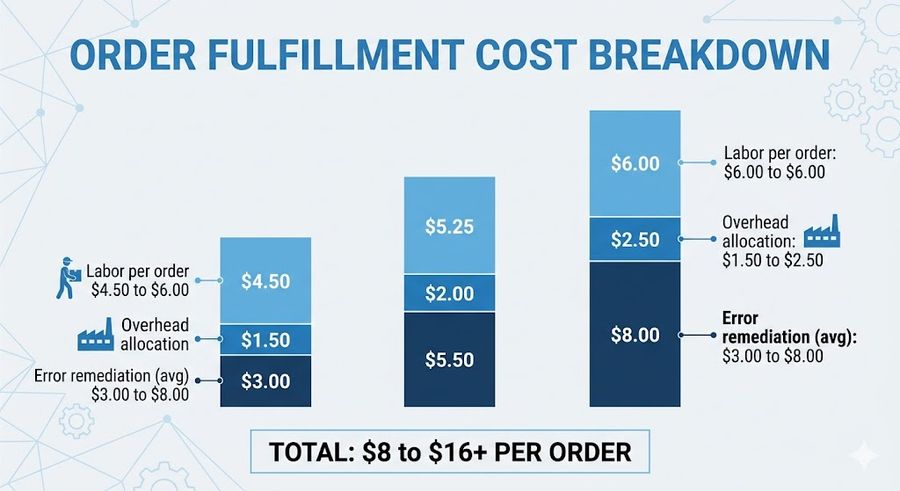
The industry benchmark sits between $8 and $15 per manually processed order, depending on labor cost, error rate, and overhead. For a distributor processing 300 orders a day, that is $2,400 to $4,500 in daily processing cost before a single product ships. Most of it is invisible because it is buried in salaries, corrections, and time that never gets tracked.
This article breaks down exactly where that cost comes from, what gets missed in most calculations, and what it actually means for a mid-size distribution operation running on manual entry.
The $8 Baseline: Where the Number Comes From
The $8 figure is a floor, not an average. It assumes a reasonably experienced CSR, a clean and consistent order format, and no errors. Here is the breakdown.
Labor time per order: $4.50 to $6.00
The average manual order takes 5 to 8 minutes to process end-to-end: opening the email or fax, identifying the customer, looking up SKUs, checking inventory, applying pricing, entering the order into the ERP, and sending a confirmation. At a loaded CSR cost of $22 to $28 per hour (salary plus benefits), that comes to $1.83 to $3.73 per order in pure labor.
But that number assumes the CSR is doing nothing else. In practice, phone calls interrupt the process, questions from colleagues interrupt the process, and system slowness adds friction at every step. Time studies in distribution environments consistently show that actual processing time per order runs 30 to 40 percent higher than the task itself would suggest. The realistic labor cost per clean order sits at $4.50 to $6.00.
Overhead allocation: $1.50 to $2.50
Desk space, computer, software licenses, supervision, HR overhead. These costs scale with headcount. Most operations allocate $25,000 to $40,000 per year in overhead per full-time CSR. Spread across the orders that CSR processes annually, the overhead contribution per order runs $1.50 to $2.50.
That gets you to $6 to $8.50 per clean order with no errors. Most orders are not clean.
What Gets Missed: The Error Multiplier
The $8 baseline assumes a zero-error order. The industry average error rate on manual order entry runs between 3 and 8 percent of order lines. On a 300-order-per-day operation with an average of 4 line items per order, that is 36 to 96 error-affected line items every single day.
Here is what each error type actually costs to fix:
Wrong SKU or product: The wrong item ships, the customer calls, a return is initiated, the correct item is reshipped. Logistics cost: $60 to $180. Customer service time: 20 to 40 minutes. Total cost per incident: $80 to $220.
Wrong pricing tier: The order goes through at standard rate when the customer has a contracted price. The customer notices on the invoice, calls back, and a credit note is issued. Finance time plus CSR time plus customer relationship friction: $40 to $120 per incident.
Wrong quantity: Either the customer receives too little (production delay, emergency reorder) or too much (return logistics, storage issue). Total cost depending on direction: $30 to $150 per incident.
Wrong ship-to address: Carrier rerouting or redelivery, plus the delay. Cost: $60 to $200 per incident.
Missed backorder flag: Item is out of stock but the order confirms anyway. Customer discovers the problem at expected delivery. Emergency sourcing, expedite fee, customer escalation. Cost: $100 to $400 per incident.
At a 5 percent error rate on 1,200 daily line items, that is 60 error incidents per day. Even at the low end of cost per error ($50 average across types), that is $3,000 in daily error remediation cost on top of the base processing cost.
The Opportunity Cost Layer
None of the above captures the cost of what does not happen because CSRs are processing orders manually.
A CSR spending 5 hours per day on order entry is not spending 5 hours on proactive customer contact, upselling, resolving issues before they escalate, or identifying at-risk accounts. Those activities have real revenue value that is simply absent from the operation.
Separately, manual processing creates confirmation delays. An order placed at 8 AM that is not confirmed until 11 AM represents a 3-hour window where the customer has no visibility. Some percentage of those customers call to check, generating inbound volume that consumes even more CSR time. Some percentage do not call, and quietly place the same order with a competitor who confirms faster.
Neither of these costs appears on any ledger. Both are real.
The Real Math for a 300-Order-Per-Day Operation
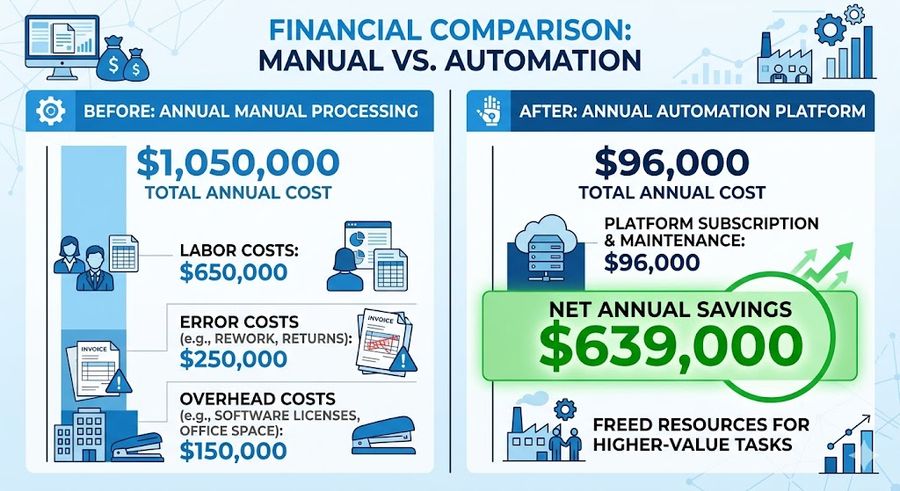
Here are specific numbers for a representative mid-size distributor:
MANUFACTURING
READY TO AUTOMATE?
Automate your order intake end-to-end
From email to ERP in seconds — no manual entry, no errors.

++
+

