 orderflow
 AI Agents vs RPA: Why Industrial Operations Are Making the Switch
RPA automates screens. AI agents automate decisions. Why the distinction matters — and when each approach makes sense.
++
AI Agents vs RPA: Why Industrial Operations Are Making the Switch
The question comes up in nearly every automation conversation in industrial operations: should we use RPA or AI agents? The two technologies are often grouped together under the label of automation, but they work differently, fail differently, and solve different problems. Understanding the distinction is not academic — it determines whether your automation project succeeds or collapses the first time an exception arrives.
This article explains what each technology actually does, where each one breaks down, and which problems belong to which tool.
What RPA Actually Does
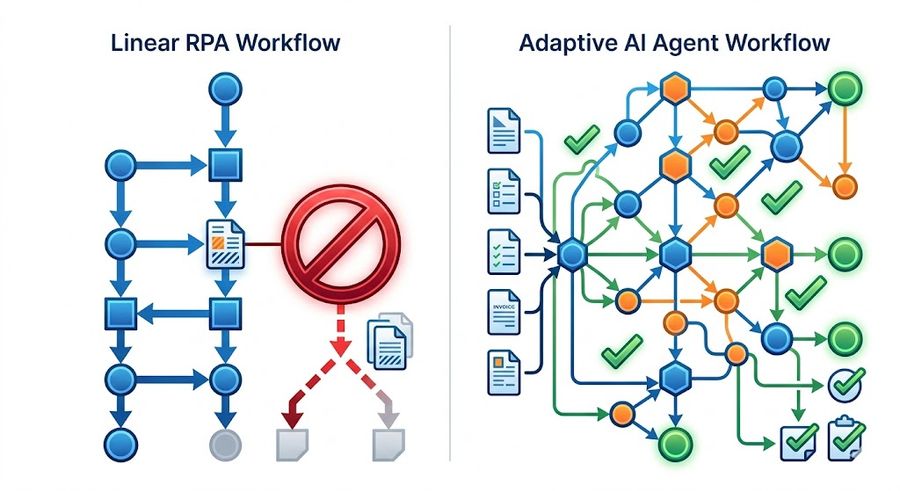
Robotic Process Automation works by recording and replaying interactions with software interfaces. An RPA bot observes a human navigating a screen — opening a file, clicking a field, entering a value, moving to the next field — and then executes that same sequence automatically. The bot does not understand what it is doing. It follows a script.
This makes RPA fast to deploy in stable environments. If you have a process where a human always opens the same screen, copies a value from one field, and pastes it into another field in a different system, an RPA bot can do that at high speed with no errors — as long as nothing changes. The moment the interface updates, the field moves, the file arrives in a slightly different format, or a required field is missing, the bot stops.
RPA failure modes in industrial operations are well documented. A purchase order that arrives with the supplier name in a slightly different format breaks the extraction. A new ERP update that moves a field two pixels to the right breaks the click sequence. A scanned document with a coffee stain covering part of the page breaks the OCR layer that RPA relies on. Each of these requires a developer to fix the bot before processing can resume.
What AI Agents Actually Do
An AI agent is software that understands the content of a task rather than the visual representation of it. When an AI agent processes a purchase order, it does not look for the PO number in a specific pixel location on the page. It understands what a PO number is, what format it takes, and where it typically appears across thousands of document variations. It finds the PO number whether it appears in the top-left corner, the top-right corner, in a table header, or embedded in a paragraph.
AI agents operate through APIs rather than screen interfaces. A Mirage Metrics agent connecting to SAP calls the SAP API directly — it does not navigate the SAP GUI. This means the agent is immune to interface changes. When SAP releases an update that changes the layout of the order entry screen, the agent is unaffected because it was never using that screen in the first place.
The critical capability that differentiates AI agents from RPA is exception handling. When an AI agent encounters a document it has not seen before, it does not stop. It applies reasoning to determine the most likely interpretation, flags the elements it is uncertain about, routes the exception to the right person with full context attached, and continues processing the rest of the batch. The human handles the exception. The agent handles everything else.
The Core Difference: Scripts vs Reasoning
The fundamental distinction between RPA and AI agents is the difference between executing a script and applying reasoning.
RPA executes a fixed sequence of actions. Every possible case must be anticipated and coded in advance. A process with 50 possible variations requires 50 branches in the script. Adding a 51st variation requires modifying the code. The maintenance burden grows with the complexity and variability of the process.
AI agents apply reasoning to each case individually. A new document format does not require a code change — it requires the agent to reason about the new format and determine how to handle it. Most of the time, this happens automatically. Edge cases that require human judgment are escalated. The maintenance burden does not grow linearly with process complexity.
This difference matters most in industrial operations, where data variability is the norm rather than the exception. A mid-size HVAC distributor receives purchase orders from hundreds of contractors, each with their own format, their own item code conventions, and their own way of specifying delivery requirements. An RPA bot that processes standard orders will fail on a significant percentage of real-world volume. An AI agent handles the variation as part of its core function.
Where RPA Still Makes Sense
RPA is not obsolete. There are categories of tasks where it remains the right tool.
Stable, structured processes:
If you have a process where the input is always in exactly the same format, the steps never change, and exceptions are extremely rare, RPA delivers automation at low cost and high speed. Copying data between two legacy systems that expose no API, generating a standard report from a fixed template, or moving a file from one folder to another based on a fixed naming convention are all good RPA candidates.
Legacy systems without APIs:
Some older enterprise systems expose no API and cannot be integrated with directly. RPA's ability to interact through the visual interface makes it the only option for automating these systems without replacing them. In practice, many industrial operations use RPA as a bridge for legacy systems while moving to AI agents for the processes that involve variable data.
Where AI Agents Are Required
The following categories of industrial processes require AI agents rather than RPA.
Document processing with variable formats:
Purchase orders, shipping documents, invoices, and contracts arrive from multiple sources in multiple formats. The number of distinct formats in a mid-size operation typically runs into the hundreds. RPA cannot handle this variability without a separate script for each format. AI agents handle it natively.
Cross-system orchestration:
A process that requires reading data from an email, validating it against an ERP, checking inventory in a WMS, generating a confirmation in a TMS, and notifying a customer via a CRM involves five systems with five different data structures. AI agents orchestrate multi-system workflows with full data validation at each step. RPA can be chained across systems but breaks whenever any one system changes or returns unexpected data.
Exception-heavy processes:
In order processing, the exception rate for manual entry in industrial distribution runs between 3 and 8 percent of total volume. For an operation processing 400 orders per day, that is 12 to 32 exceptions daily that require human review. AI agents route exceptions automatically with context, reducing the time a human spends on each exception from 15 to 20 minutes to 2 to 3 minutes of review and approval.
The Real Cost Comparison
RPA is often presented as the lower-cost option. This is accurate for the initial deployment but frequently inverts over time.
The initial cost of an RPA deployment for a single process is typically lower than an AI agent deployment for the same process. A simple bot can be deployed in days. The ongoing maintenance cost is where the comparison shifts. RPA bots in industrial environments require maintenance each time an interface changes, a new document format appears, or a process step is modified. Large RPA deployments in industrial companies typically require a dedicated maintenance team.
AI agents require more upfront work to configure the data models, validation rules, and escalation paths. Once deployed, the maintenance requirement is lower because the agent adapts to variation rather than breaking on it. New document formats are handled through training updates rather than code rewrites. Interface changes in connected systems are irrelevant because the integration is through APIs.
The break-even point varies by process complexity and change rate, but for processes with more than moderate variability — which describes most document-heavy industrial workflows — AI agents typically have lower total cost of ownership over a two-year horizon.
What Mirage Metrics Builds
Mirage Metrics builds AI agents for industrial operations — specifically for the document-heavy, multi-system, exception-prone processes that RPA cannot handle reliably. OrderFlow automates order entry from any channel into any ERP. CargoScribe automates document processing across freight and supply chain workflows. Both agents connect through direct API integrations, handle variable input formats natively, and route exceptions to human reviewers with full context.
The question of RPA vs AI agents is ultimately a question of whether your process has the stability that RPA requires or the variability that AI agents are built for. Most industrial document workflows have the variability. That is why the switch is happening.
MANUFACTURING
READY TO AUTOMATE?
Automate your order intake end-to-end
From email to ERP in seconds — no manual entry, no errors.

++
+
More articles like this
orderflow  orderflow
  orderflow