
 Manufacturing
PDF Purchase Order Processing: OCR, AI, or Agents
OCR, documentary AI, or autonomous agents: which technology should you choose to automate your PDF purchase order processing in 2026?
Automated PDF Purchase Order Processing: OCR, AI, or Agents. What to Choose in 2026
A customer sends you a PDF. Your team opens it, reads it, types the order into your ERP. Three minutes per order, sometimes ten. Multiply that by fifty orders a day and you understand why companies are looking for automation solutions.
But faced with three families of technologies, OCR, documentary AI, and autonomous agents, how do you find your way? This guide compares them concretely in the context of industrial distributors who process between 30 and 300 PDF orders per day.
Why PDF Purchase Orders Are Still a Headache in 2026
Despite the rise of EDI and e-procurement portals, a large majority of B2B orders still arrive in PDF format. The reasons are structural: SME customers don't invest in EDI connectors, purchasing departments work with Word or Excel templates converted to PDF, and email remains the dominant communication channel in many industrial sectors.
The result: your operations teams spend a significant portion of their time on manual re-entry, with all the associated risks including input errors, delays, and customer dissatisfaction.
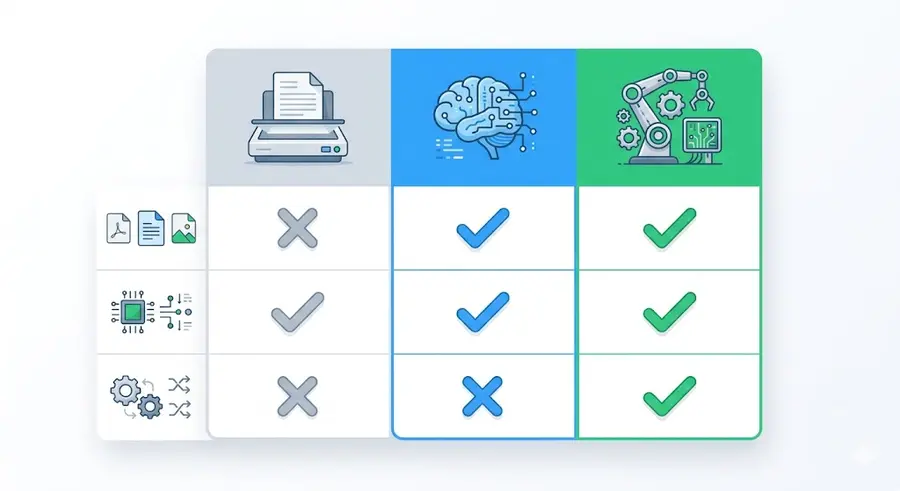
Technology 1: Traditional OCR
Optical Character Recognition converts a scanned image or PDF into machine-readable text. It's the oldest technology in the field, available since the 1990s.
How it works: OCR reads each character visually and reconstructs the text. For structured documents (always the same format, same position), it can extract fields like order number, product reference, quantity.
Its limits in practice:
Traditional OCR struggles with variation. If customer A sends a PDF with the order number in the top right and customer B puts it in the middle left, you need two separate rules. With 50 customer formats, you maintain 50 configurations.
Also, OCR extracts text but doesn't understand meaning. It can read "REF: 47821" without knowing it's a product reference. Business logic (mapping to your ERP references, validation rules) must be programmed separately.
When OCR makes sense: If you receive orders from a very limited number of customers (less than 10) who always send the same format, template-based OCR can be efficient and inexpensive.
Technology 2: Documentary AI
Documentary AI, also called IDP or Intelligent Document Processing, adds a machine learning layer on top of OCR. Instead of relying on fixed positions, the model learns to recognize fields semantically.
How it works: The AI model is trained on thousands of labeled documents. It learns that "Order No.", "PO Number", "Purchase Order #" all designate the same field, regardless of their position in the document.
Its advantages over OCR:
Documentary AI handles format variation much better. It can process documents from new customers without specific configuration, as long as the language and structure remain similar.
It also produces confidence scores: for each extracted field, the system indicates how certain it is. A human can therefore review only ambiguous cases rather than all documents.
Its limits:
Documentary AI extracts information but doesn't act. Once it has identified the order number, product reference, and quantities, someone or something still has to enter this data into the ERP, verify stock, create the order. The last mile remains manual or requires additional development.
Also, performance depends heavily on training data quality. A model trained mainly on French documents will struggle with Moroccan Arabic or Darija documents.
Technology 3: Autonomous Agents
Autonomous agents are AI systems capable of performing multi-step tasks without human intervention. Instead of just extracting data, they act: they open the ERP, create the order, send the confirmation.
How it works: An agent receives a PDF and analyzes it using OCR and AI capabilities. Then it executes a sequence of actions, which includes consulting stock, verifying pricing, creating the line items in the ERP, and sending an acknowledgment email to the customer.
What changes compared to previous approaches:
The agent handles the complete process, not just extraction. It can handle business rules: if a referenced product is out of stock, substitute it with an equivalent and notify the customer. If the order exceeds a certain amount, send it for approval before entry.
Adaptability is also greater: an agent can learn from corrections. If an operator modifies an automatically created order, the agent integrates this correction into its future behavior.
The current limits of agents:
Agents require more sophisticated infrastructure and careful deployment. They need controlled access to your ERP systems, well-defined rollback procedures if they make a mistake, and robust human validation on edge cases.
The initial investment is higher, but the ROI is also greater because the entire process is automated, not just extraction.
Comparison: Which Technology for Your Situation?
Volume of PDF orders per day
For low volume (less than 20 orders/day), template OCR may suffice if your customers are regular and standardized.
For medium volume (20 to 100 orders/day) with varied formats, documentary AI significantly reduces manual workload by automating extraction while keeping a human validation step.
For high volume (more than 100 orders/day) or when you want to free up your team for higher-value tasks, autonomous agents offer complete automation with measurable ROI.
Customer format diversity
Few standardized customers: OCR is sufficient. Many customers with varied formats: documentary AI or agents are necessary.
Desired level of automation
Extract only: documentary AI. Extract and enter into ERP: agents.
The Moroccan Industrial Context
Several characteristics of the Moroccan market influence the choice of technology.
Bilingualism is the norm: orders arrive in French, Arabic, or both. Models must be trained on this linguistic reality, under penalty of poor performance.
SME customers: a large part of your order flow comes from small structures that will never invest in EDI. The PDF format is there to stay. Automating its processing is therefore a structural priority, not a one-time project.
ERP diversity: SAP, Microsoft Dynamics, Odoo, Sage. The Moroccan market is heterogeneous. Your automation solution must integrate with your specific ERP, not just the most common ones.
Freezing regulations and import rules regularly change, affecting product references and customs codes. Your automation system must be able to quickly integrate these changes.
How OrderFlow Approaches This Problem
OrderFlow combines documentary AI and agent capabilities to offer end-to-end automation of PDF purchase orders.
The document analysis layer handles format variety: customers who send different PDFs each time, mix of French and Arabic, scanned or native documents.
The agent layer handles ERP entry: once data is extracted and validated, the agent creates the order in your system, consults stock, applies pricing rules, and sends an acknowledgment.
The human validation interface lets your operators process exceptions quickly: a dashboard shows orders requiring attention, with clear explanations of why automated processing was stopped.
The result is typically a 70 to 85% reduction in manual re-entry time, with error rates divided by 5 to 10.
What to Watch Out for When Evaluating Solutions
Before committing to a solution, ask these questions:
On extraction performance: What is the accuracy rate on documents similar to yours? Request a test on your own PDF samples, not generic demos.
On ERP integration: Does the solution integrate natively with your ERP or does it require custom development? What are the maintenance costs?
On exception handling: What happens when the system is uncertain? Is there a clear human escalation path?
On training and adaptation: How does the solution handle new customer formats? Is model retraining automatic or does it require intervention?
On Moroccan linguistic context: Has the solution been tested on French-Arabic bilingual documents? What are the specific performance metrics?
Follow Mirage Metrics on Google
MANUFACTURING
READY TO AUTOMATE?
Automate your order intake end-to-end
From email to ERP in seconds, no manual entry, no errors.
More articles like this
Manufacturing Manufacturing
 Manufacturing